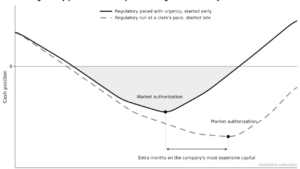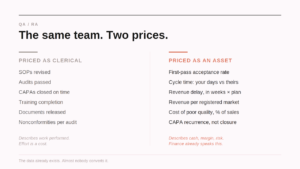

“Compliance is where you start. Strategic regulatory capability is a moat.”
The New Baseline
Not a science degree. Not a regulatory certificate. A Juris Doctor, an active license, and eight years practicing law.
That was the floor: the minimum a billion-dollar consumer health company set for a job most companies quietly hand to a regulatory affairs manager. The kind of credential you expect from someone who defends companies in court, not someone who files their paperwork.
Read that again. They decided the person guiding their regulatory pathway should first be a litigator. Not a scientist who learned the rules. A lawyer trained to argue them.
And it was not a one-off. The same company was hiring a senior regulatory counsel to sit beside its regulatory affairs team, and above both, a director of global legal strategy whose entire remit is regulatory inquiries, enforcement matters, and policy interpretation.
Look at what that structure actually is. It is a war room.
One layer keeps the submissions clean. The layer above it exists to engage regulators as equals, to influence how the rules get read, and to defend the pathway so that no ambiguity and no loophole can ever be turned against a product worth billions.
Most organizations staff only the first layer. Then they call it “regulatory.”
Why the Stakes Matter
Here is why this should stop every executive mid-scroll, whatever seat you hold.
If you run product, understand this: the entire business hinges on one contested line, whether your software is classified as a regulated medical device, and on whose terms. That question is not settled by science. It is settled by argument. Which side you land on decides what your product is even allowed to do.
If you run revenue, that same line decides what you are legally allowed to claim, and therefore what you are allowed to sell.
If you run finance, it decides your time to market, your liability exposure, and a meaningful share of your valuation.
And here is the part that should keep all of you up at night: that line is not fixed. It moves. It moves with guidance, with interpretation, with enforcement mood. The FDA quietly redrew part of it in early 2026.
A company that treats regulation as paperwork feels that movement as risk. A company that has built real regulatory firepower feels it as leverage. Same line. Opposite outcomes. The only variable is who you hired before you needed them.
Building Real Defense
None of this is about gaming safety. Nobody builds a function like this to hurt patients. But history is honest. Even great companies face recalls and legal battles. The only question that matters is whether you meet that day scrambling to interpret your own file under pressure, or standing on ground you spent years preparing.
So here is the uncomfortable truth, and I put myself inside it. Passing audits and filing clean is table stakes. It is the cost of entry, nothing more. The capability that actually protects and compounds enterprise value sits far above it. Regulatory intelligence used as foresight. Command of the legal reasoning underneath the frameworks, not just their checklists. The instinct to see an enforcement action three moves before it arrives, so that if it ever comes, it loses.
That posting did not make me feel behind. It showed me the ceiling, and how few of us are anywhere near it.
Compliance is where you start. Strategic regulatory capability is a moat, and it gets built quietly, years before anyone can see why it mattered.
If your regulatory function only files, you do not have a moat. You have a queue. And somewhere, a competitor just hired the person who will make you feel the differen