“A model drafts that file in an afternoon. It does not carry the weight of having been wrong, and every serious framework we work under… is built so that the weight lands on a named human being.”
The Fear of Replacement
When i asked a room of quality and regulatory people what they are quietly afraid of, and eventually someone says it plainly: that within a few years an AI model will do all of this, and the rest of us will be left initialling its output. The fear is real, but I have come to think it is aimed at the wrong side of thing.
The Toll of Production
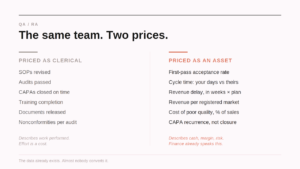
Most of what fills a quality professional’s week has always been production. Someone writes the procedure, assembles a slice of the technical documentation, works the literature into a clinical evaluation, and files it in a shape a reviewer will accept without a fight. That work was real, and it was the least of what the job asked. It was the toll you paid to reach the part that mattered. A capable LLM model now pays that toll in minutes, competently enough that anyone whose reputation rested on being fast and neat at a keyboard is right to feel the floor tilt.
The Weight of Accountability
What the model cannot touch is the part of the job that never fit inside a document in the first place. When you close a CAPA, the hard part was never the writing up. It was deciding, with your name beside the decision, whether the corrective action truly held, whether the effectiveness evidence means what it seems to mean, and whether you would still stand behind that call a year and a half later when an auditor reopens it in front of you and asks you to walk them through it. A model drafts that file in an afternoon. It does not carry the weight of having been wrong, and every serious framework we work under, from the FDA’s rules for device software to the EU’s Medical Device Regulation, is built so that the weight lands on a named human being.
The Cost of Drift
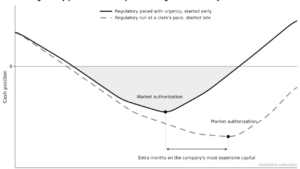
There is a second shift, quieter and more useful, that gets drowned out by the noise about replacement. The failures that actually wound a quality system are almost never failures of intelligence. They are failures of disipline or attention stretched across time. The effectiveness check that came due in a busy week and slipped. The reportable event whose clock ran out before anyone realised it had started. The same evidence sent to two notified bodies in two subtly different forms, leaving an inconsistency no one intended for a reviewer to find. The procedure still quoting a standard that was superseded last spring, sitting untouched until an auditor turns to that page. The submission that could have been built calmly over months and was instead thrown together in a fortnight of panic, because preparation began only when the deadline came into view. None of these needs genius to prevent. Each needs a patient, unbroken watchfulness that human teams, however good, have never sustained for long. That is precisely the labour a system can carry without tiring: holding the dates, noticing the drift, reconciling what went where, and keeping the file close enough to ready that a submission becomes a scheduled event instead of an emergency.
The Compliance Gap
This is where the story turns awkward, because the system that ought to be doing all of this is the one we have most neglected. Whatever you choose to call it, the thing running underneath a modern quality operation now has to do far more than store documents. It has to understand time and obligation not just by a notification. It has to know that a standard has changed and which procedures that change touches. It has to hold, lawfully and with care, a great deal of personal data, the names inside complaints, the patients behind adverse events, the auditors and employees whose records sit in the same place, all of it squarely within the reach of the GDPR. It has to be, in effect, a piece of trustworthy software governing regulated work. Which means the tool that manages your compliance has quietly become something that must itself be compliant.
The Stone Age Tools
Hold that expectation up against what is actually sold as an eQMS, and the gap is almost embarrassing. A great deal of it is document management with a more expensive login. Much of the rest is a task tracker in a good suit, a place to drag a card between columns and call the movement quality or a notification system for each of us in team. For a field that prides itself on rigour, the instruments we still run our quality systems on belong, more or less, to the stone age.
Regulatory Realities
The regulators, tellingly, are already ahead of the vendors. The FDA has been running generative AI inside its own review centres since 2025, and has still not cleared a single generative-AI device for market. It lets the technology draft and accelerate while keeping every judgment in human hands, having read correctly that accountability has to live with a person. That is the exact shape the rest of us should be building toward: machines that carry the drafting and the vigilance, humans who carry the decisions, and a system honest enough to keep the two apart.
References
- FDA, Artificial Intelligence in Software as a Medical Device: https://www.fda.gov/medical-devices/software-medical-device-samd/artificial-intelligence-software-medical-device
- FDA internal deployment of generative AI and regulation of health AI tools (2025): https://bipartisanpolicy.org/issue-brief/fda-oversight-understanding-the-regulation-of-health-ai-tools/
- Regulatory status of generative-AI-enabled devices (2026): https://www.everycrsreport.com/reports/IF13245.html
- EU Medical Device Regulation (Regulation 2017/745), consolidated text: https://eur-lex.europa.eu/eli/reg/2017/745/2025-01-10/eng
- General Data Protection Regulation (Regulation 2016/679): https://eur-lex.europa.eu/eli/reg/2016/679/oj/eng