
A room full of expensive specialists holds its breath for a date that feels out of everyone’s hands, while the company slows to the speed of a single file moving from one desk to the next.
What your timeline is actually made of
Watch how the work gets sequenced. The design closes, and then someone starts assembling the design history file. The design freezes, and then the clinical evaluation begins. Everything else is finished, and then the final reports get written. Each step waits for a clean handoff from the step before it.
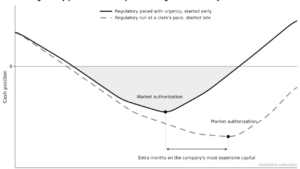
Line those steps up end to end and you have your timeline. What makes it painful is that most of the timeline is the gaps. Suppose the actual hands-on work across all of it, the writing, the analysis, the assembly, comes to a couple of months of real effort. Run it in strict sequence, with each group standing by until the group ahead of it hands over, and that couple of months can spread across the better part of a year. Most of what you pay for in that stretch is the empty space between the steps.
That is the thing a founder feels and struggles to name. The submission takes on the suspense of an IPO. A room full of expensive specialists holds its breath for a date that feels out of everyone’s hands, while the company slows to the speed of a single file moving from one desk to the next.
The two costs you are weighing without knowing it
Here is what explains why capable teams still work this way. Every submission carries two costs, and you almost certainly manage only one of them.
The first is the cost of getting it wrong. You guard that one closely. You review, you double-check, you leave yourself margin, because a rejected submission or a missed finding is expensive and visible, and everyone can picture it.
The second is the cost of the time you lose by running everything in series. That cost never arrives on anyone’s desk as a number. It shows up quietly, as months of runway spent, as a team kept on standby, as a raise slipped a quarter because the clearance was not in hand when you needed it. Since it is never measured, it is never managed, and it grows unchallenged while everyone is busy defending against the first cost.
With only one of the two costs visible, running things in strict order looks like the responsible choice. Put both in front of you and that changes.
How I would run it instead
If it were up to me, I would run the submission as a stream of work alongside the build, started early. Most of the pieces do not need the strict order they usually get.
Build the design history file from a shared template while the design is still moving, so it is assembled as you go rather than reconstructed at the end.
Run the clinical evaluation next to development and keep it current as evidence arrives, so it is complete by the time you need it.
Draft the final reports early, including the corrections you can already anticipate, so the last version is a light edit under no time pressure.
Ask the regulator for a presubmission meeting early, so the feedback that would otherwise reach you after you submit arrives while it is still cheap to act on.
None of this is exotic. It is the same work, started sooner and allowed to run at the same time.
I would not sell it to you without the downside. Overlapping work costs you some rework. Start a step before the one ahead of it is fully settled and a design detail can move, forcing you to rewrite a section you thought was closed. That is real and it is not free. So the rule I would hand you is a single question. Can this overlap put the outcome itself at risk? Where the answer is yes, hold those steps in sequence and protect the result. Where the answer is no, let them overlap and take the rework on the chin, because it is almost always smaller than the weeks of calendar it buys back.
There is also a resource sitting in plain sight. During a serialized submission most of your team is not fully loaded. They are waiting for their turn. That capacity is already on your payroll and already idle, so running work in parallel is mostly a matter of using hours you are paying for regardless.
The rule to take away
Take one habit from this and it is this. Put a rough cost on the weeks you lose to sequence, and treat that number with the same seriousness you already give the risk of a mistake. Then let every step that can safely start early start early, and carry the small rework that follows.
Do that and the submission changes character. By the time the date arrives, most of the work is already behind you, the team has been productive the whole way through, and the submission is the last short step in a job that has been moving for months. The clearance lands closer to when you actually needed it, which, for a founder, is usually the difference that matters most.