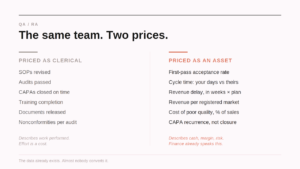

Many teams fill it with a high-functioning technical clerk. Someone who keeps the records straight, keeps the system audit-ready, closes every task correctly, and stays compliant across the file. All of that work is necessary, and a company running an approved product depends on it. The judgment error is assuming a startup crossing the valley needs the same profile in the same seat.
Visible Fronts
Cashflow and product development are already covered. The crossing depends on whether the person in the regulatory seat understands that their pace is spending the company’s most expensive capital. In a medtech company nearing commercialization, two functions are watched constantly. The CFO owns cashflow and survival, tracking runway week to week. The founder and the technical team own product development and the growing patent estate. Those are the visible fronts, and they earn the attention they get. The variable that determines when the company is legally allowed to sell sits with one person in the quality and regulatory seat, and that seat rarely receives the same scrutiny.
The Clerk Trap
Many teams fill it with a high-functioning technical clerk. Someone who keeps the records straight, keeps the system audit-ready, closes every task correctly, and stays compliant across the file. All of that work is necessary, and a company running an approved product depends on it. The judgment error is assuming a startup crossing the valley needs the same profile in the same seat.
The Cost of Time
The distinction that matters lives in a single realization. While that person methodically completes each task, they are spending the most expensive money the company holds. The interval between a working product and market authorization is financed by the most dilutive capital the company will ever raise, at its highest-risk valuation. The expense is time. Every task in that seat’s queue takes days, and those days are funded by that capital. The cost stays invisible on the operating statement and lands on the cap table at the next round.
The Decisive Variable
This is why the seat is decisive. Cashflow is already owned. Product is already owned. The one remaining variable that determines the crossing is the regulatory timeline, and it belongs to this person. At this stage, more than the CFO and more than the CTO, this person sets the date the company reaches the far side of the valley. The seat carries the crossing, and whoever sits in it decides its timing through the pace and quality of their own work.
Financial Throughput
The person who belongs there understands their throughput in financial terms. They read a slow week the way the CFO reads a cash-negative week. They make the intended-use and classification calls early, because those calls set the entire timeline. They sequence the evidence so it is built once and delivered on time. They keep the records straight as a matter of routine, and they treat the authorization date as the deliverable that actually matters. They know that the company’s most expensive resource is running through their queue, and they manage it as such.
Capital Allocation
So the framing a founder should hold is direct. The regulatory lead is a capital-allocation decision carrying a compliance title. The pace and judgment of that one person move the dilution, the cost of capital, and the terms of the next raise as much as almost any operational choice the company makes. Cashflow and product are the conditions that keep the company alive inside the valley. The regulatory seat is the one that decides when the company leaves it. Fill it with someone who understands that the timing of the crossing is theirs to set, and who feels the cost of every week they hold.