“The lab of the future is no longer a building filled with centrifuges and technicians; it is a microscopic layer of carbon atoms sitting on a silicon wafer in the palm of your hand.”
The Obsolescence of PCR
The gold standard of molecular diagnostics is undergoing a fundamental phase shift that renders the traditional laboratory model obsolete. For decades, Polymerase Chain Reaction (PCR) has been the undisputed heavy hitter of viral detection, yet its inherent flaws the requirement for thermal cycling, expensive reagents, and hours of processing time create a dangerous bottleneck during a global health crisis. As we move through 2026, the emergence of graphene based field effect transistors (g-FETs) is transitioning us from slow chemical processing to instantaneous digital detection.
The Physics of Graphene
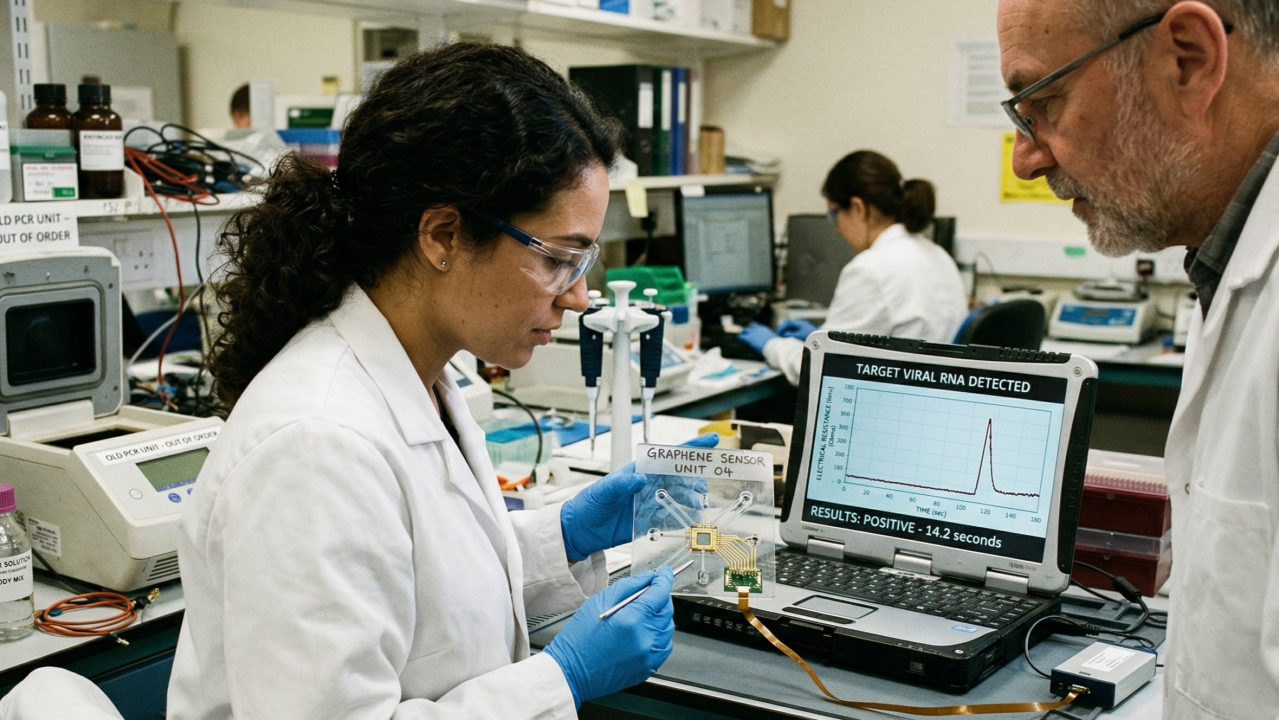
Graphene is uniquely suited for this revolution because it is a single layer of carbon atoms with extraordinary electrical conductivity and a massive surface area to volume ratio. In a solid state graphene biosensor, every single atom is exposed to the environment, meaning the slightest interaction with a viral protein or a specific RNA sequence causes a massive, measurable change in electrical resistance. We are no longer waiting for a chemical reaction to amplify a signal; we are witnessing a direct digital translation of a biological event.
Bypassing Amplification
The implications for pandemic preparedness are transformative. Traditional PCR requires “amplification,” which is effectively the biological equivalent of photocopying a document thousands of times so it becomes legible. Graphene sensors bypass this entire step because they are sensitive enough to “read” the original document. By functionalizing the graphene surface with specific antibodies or DNA probes, engineers are creating chips that can identify multiple pathogens simultaneously from a single drop of saliva or blood.
Solving the Last Mile
This shift to “Lab on a Chip” technology solves the last mile problem of diagnostics. During previous outbreaks, the delay between testing and results was the primary driver of transmission. Digital graphene platforms deliver results in seconds, not hours, and can be integrated directly into smartphones or wearable devices. This allows for real-time, decentralized surveillance where data is fed into “Agentic AI” systems to map viral spread with street level precision before a single hospital bed is filled.
Scalable Manufacturing
Furthermore, the manufacturing of these sensors has reached a tipping point. Recent breakthroughs in large scale chemical vapor deposition (CVD) and screen printing techniques allow these semiconductors to be produced at a fraction of the cost of traditional diagnostic equipment. We are moving toward a world of disposable, high precision molecular sensors that can be distributed as easily as a common bandage.
Redefining the Lab
As the industry pivots away from reagent heavy chemistry toward solid state physics, the very definition of a “lab” is changing. The lab of the future is no longer a building filled with centrifuges and technicians; it is a microscopic layer of carbon atoms sitting on a silicon wafer in the palm of your hand.
References
-
Journal of Nanobiotechnology (2025): “Graphene Field Effect Transistors for Next Generation Point of Care Diagnostics: A Review of Signal to Noise Optimization.”
Nature Biomedical Engineering (2026): “Real time molecular detection of respiratory viruses using functionalized graphene semiconductors.”
World Health Organization (WHO) Tech Report: “The transition from centralized PCR to decentralized digital molecular surveillance in pandemic preparedness.”
IdentifySensors Biologics: “Annual Report on Graphene Semiconductor Integration for Check4 Diagnostic Platforms.”