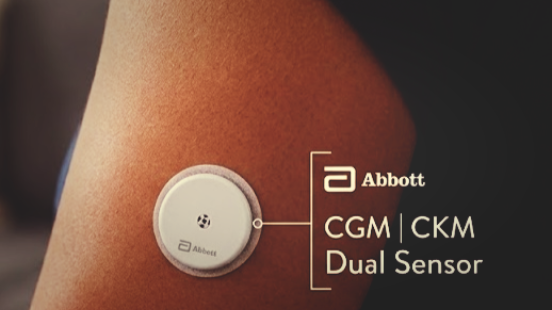
”I will be honest, when I first saw the headline that Abbott had secured CE Mark for the world’s first dual glucose-ketone continuous biosensor on 27 May 2026, my first reaction was “impressive, but how hard could it really be?”
After digging into the technical literature, the regulatory timeline, and the clinical validation pathway, I want to take that back completely.
This was one of the most technically demanding IVD development and clinical validation programmes I have come across in recent memory. And the medtech and diagnostics community is not talking about it loudly enough.”
Where we Started: The finger-prick era and its limits
Before continuous dual biowearables, the clinical standard for simultaneous glucose and ketone tracking was point-in-time blood meters. Devices like the Keto-Mojo, CareSens Dual, and Abbott’s own Precision Xtra are all widely cleared by the FDA, but they require separate finger-prick test strips for each analyte. No streaming. No trend data. No integration with insulin delivery algorithms. A snapshot, not a film.
The clinical limitation is not subtle. Diabetic ketoacidosis develops within hours and its early symptoms, nausea, fatigue, flu-like illness, are routinely mistaken for infections. By the time someone decides to do a finger-prick, the metabolic cascade may already be advanced. And here is the number that stopped me: DKA rates in adults with type 1 diabetes more than tripled over a 23-year UK study period, while in type 2 diabetes patients the increase was sixfold. DKA accounts for roughly four times more hospitalisations than hypoglycaemia.
Continuous, simultaneous dual-analyte monitoring is not a nice-to-have. It is a clinical necessity the previous generation of Medical Device could not address.
The Technical Problem Abbott had to Solve
This is where it gets genuinely interesting for those of us who work in MD development and validation.
A peer-reviewed paper published this year in the Journal of Diabetes Science and Technology by Abbott’s own team describes what they were up against. Both glucose-sensing and ketone-sensing are enzymatic amperometric processes, they yield electrical currents as raw signals. That sounds straightforward until you try to put both chemistries on a single subcutaneous sensor that has to be factory-calibrated, worn for up to 15 days, remain accurate across the full physiological range, and not have one analyte electrically interfere with the other.
The paper is direct about what the actual hurdle was: placing two chemistry matrices with high precision on two spatially separated electrodes without cross-contamination required the development of entirely new precision solution dispensing technology.
Read that again. They had to invent a new manufacturing process to make this sensor viable at commercial scale. This is not an incremental improvement. This is original engineering.
And then there is the factory calibration problem. Abbott pioneered factory-calibrated subcutaneous glucose sensing commercially with the original FreeStyle Libre in 2014, a breakthrough that eliminated the need for user fingerstick calibration. Replicating that for ketones, simultaneously, while ensuring the glucose calibration was not affected by the presence of ketone-sensing chemistry on a neighbouring electrode, on a sensor the size of two stacked coins, required entirely new calibration algorithms and validation frameworks.
The Clinical Validation: Why it took longer than expected?
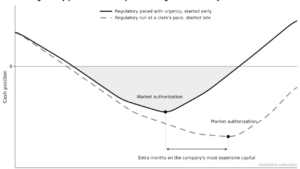
Abbott announced development of the dual sensor in June 2022 and planned pivotal trials for 2023, with regulatory submissions to follow. The CE Mark came in May 2026. That is approximately four years from announcement to European market approval for a genuinely novel device class.
For those outside the Medical Device regulatory world, four years sounds long. For those of us inside it, it sounds about right, and here is why.
The clinical validation of a dual-analyte continuous biosensor has to satisfy regulators on two separate performance claims simultaneously. Under MDR, the analytical performance requirements for glucose measurement alone are substantial, accuracy, precision, linearity, interferent testing, stability across wear duration, and clinical correlation data. Ketone measurement adds an entirely parallel set of requirements, and the combination adds a third layer: you must demonstrate that measuring both analytes concurrently does not degrade the performance of either.
A 2025 interference study published in MDPI Sensors demonstrated just how vulnerable CGM sensors are to endogenous and pharmaceutical interferents, substances including ascorbic acid, ibuprofen, acetaminophen, and even red wine were shown to create significant bias in Abbott and Dexcom devices under dynamic testing conditions. For a dual-analyte sensor, every interferent had to be evaluated for its effect on both analytes independently and in combination. That is a substantial analytical validation burden.
Add to this the FDA Breakthrough Device designation, which signals the device addresses a life-threatening condition and qualifies for expedited review, and the interoperability requirements for integration with automated insulin delivery systems, and you begin to understand the full scope of what Abbott’s regulatory team was executing across two parallel submissions simultaneously: MDR in Europe and FDA in the US.
The CE Mark is confirmed. FDA approval is expected in H2 2026, per Abbott CEO Robert Ford.
Abbott vs Dexcom: How the platforms actually differ and why it matters here
It is worth understanding why Abbott, and not Dexcom, is first to a dual-analyte CE Mark.
Abbott’s FreeStyle Libre platform reads glucose every minute with a 15-day wear time and is factory-calibrated. Dexcom G7 reads every 5 minutes with a 10-day standard wear time and a faster 30-minute warm-up versus Abbott’s 60 minutes. Both are excellent platforms. But Abbott’s factory calibration architecture, built over more than a decade, is what made the dual-analyte sensor technically feasible without requiring user calibration of the ketone component. Dexcom’s approach relies more heavily on in-use calibration processes that would complicate dual-analyte implementation.
This is a case where years of upstream platform investment in calibration science paid off in a downstream product category that competitors cannot easily replicate in the short term.
What the Regulatory Community should learn from this
I have spent 14 years in IVD and medical device regulatory affairs, and a few things stand out here that I think the broader community should internalise.
Breakthrough Device Designation is not just a fast lane, it shapes the clinical validation strategy. Abbott secured FDA BDD for the dual sensor early, which means they had a structured dialogue with FDA on clinical evidence requirements before pivotal trials began. That upstream regulatory investment is why they could run a pivotal trial in 2023 and reach CE Mark by 2026, rather than discovering evidence gaps late.
Novel device categories require novel clinical validation frameworks. There was no established precedent for a continuous dual-analyte subcutaneous biosensor under IVDR or FDA. Abbott’s team had to build the analytical and clinical validation framework essentially from scratch. That is a significant regulatory science contribution that benefits the entire field, the next company attempting a multi-analyte continuous sensor will reference this pathway.
The interoperability layer is the underappreciated regulatory complexity. MiniMed’s expanded partnership announcement on 3 June 2026 to integrate the dual sensor with its smart dosing systems adds another layer entirely: system-level validation under MDR Article 22 companion device provisions and FDA’s iCGM/ACE pump framework. Both analyte claims must survive the interoperability environment. That is a regulatory complexity most single-analyte sensors never have to address.
The CKM dimension I am not seeing discussed anywhere
The American Heart Association’s CKM syndrome framework, Cardiovascular-Kidney-Metabolic, stages multisystem risk from Stage 0 through Stage 4. SGLT2 inhibitors, now the backbone pharmacotherapy for CKM risk reduction, induce mild ketonaemia as part of their mechanism of action. For patients on SGLT2 inhibitors with overlapping heart failure and CKD, continuous ketone monitoring is not a distant clinical application, it is an immediately relevant safety question.
Nobody is yet connecting Abbott’s Libre Duo to this population. That intersection deserves a clinical study.
Why I am genuinely impressed
I have been involved in enough Medical Device development and regulatory programmes to recognise when something was exceptionally hard to execute. The Libre Duo CE Mark represents the convergence of original sensor chemistry, new manufacturing technology, parallel dual-analyte analytical validation, a multi-country clinical programme, simultaneous MDR and FDA regulatory submissions, and interoperability claims across multiple insulin delivery partners.
It took four years. It should have taken four years.
The MDR industry sets the standard for rigour in clinical validation precisely because the consequences of getting it wrong are measured in patient outcomes. What Abbott demonstrated with the Libre Duo programme is that the highest level of that rigour is achievable even in genuinely novel territory.
That is worth acknowledging.