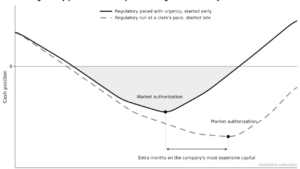

”The manufacturers who hold EU market access will be the ones who understood that regulatory readiness is the condition under which product development has commercial value at all”.
The Regulatory Silence
There is a particular kind of silence that falls over a regulatory affairs team when they realize the deadline they assumed was theoretical was, in fact, real. It has been settling across medtech boardrooms since May 26, 2026. For some, it settled two years earlier. The product exists, the clinical data exists, the market is there. What stands between all of that and legal EU market access is a conformity assessment certificate that a shrinking pool of Notified Bodies is responsible for issuing. Understanding why that pool is shrinking, and what it means for manufacturers on both sides of the MDR and IVDR divide, is where any serious recovery plan has to begin.
MDR Pipeline Realities
The Team-NB survey covering data through end of 2025 puts the MDR picture in stark terms: 25,978 applications submitted, 13,953 certificates issued. Roughly 12,000 applications are sitting somewhere in the pipeline across a Notified Body ecosystem that has contracted from approximately 80 bodies under the old MDD to 45 to 50 under MDR today. Certificate issuance doubled between 2023 and 2024, then slowed to 45% growth between 2024 and 2025. The acceleration the system needed to close the gap is already fading, and the most complex device classes are still working through transition. Review timelines are running 12 to 18 months for the majority of applications, and that figure assumes a complete, well-prepared submission. The same Team-NB data reveals that 65% of submitted MDR files lack at least half of the required information. Incomplete files push that timeline further still.
IVDR Structural Pressures
IVDR tells a structurally different story with the same underlying logic. The European Commission’s 18th Notified Bodies Survey published March 2026 shows 3,634 applications submitted against 2,194 certificates issued. The Team-NB end-2025 figures put it at 3,021 applications and 2,500 certificates, a pending gap that in absolute numbers looks contained. It is not. Only 19 Notified Bodies are currently designated under IVDR. Under the old IVDD, fewer than 15% of IVDs required Notified Body involvement at all. Under IVDR, that figure rises to approximately 90%. Nineteen bodies absorbing a sixfold increase in conformity assessment scope, while the same Team-NB survey reports that those bodies were forced to lay off staff in 2025 to maintain financial operations, with auditor training timelines meaning that capacity, once shed, does not return quickly. The Class C application wave that May 2026 was supposed to trigger has only just begun to arrive. The current gap of roughly 500 to 600 pending IVDR applications will not look manageable six months from now. Across both regulations, 85% of all certificates issued in 2025 were MDR and 15% were IVDR. The IVD certification machinery is running well below the throughput the incoming volume will require.
Navigating MDR Application Gates
The MDR application gates were May 26, 2024 for formal submission and September 26, 2024 for a signed written agreement with a Notified Body. Manufacturers who met both milestones are in transition, extended to December 31, 2027 for Class III and most implantable Class IIb devices, and December 31, 2028 for other eligible classes, and are now managing the certification process itself against a 12 to 18 month NB review clock. Manufacturers who missed one or both gates are in a materially different position. The extended MDR transition is not available to them. Article 59 MDR derogation, applied for through the competent authority of the relevant Member State on the grounds that withdrawal would create a genuine supply risk, is the only formal bridge remaining. It requires filing before the device is withdrawn, not after. It buys time. It does not replace the certification path, which has to run in parallel from the moment the derogation application is made.
IVDR Class C Deadlines
For IVDR Class C, the formal application deadline was May 26, 2026. A signed written agreement with a Notified Body must follow by September 26, 2026, with the final transition deadline sitting at December 31, 2028. Missing the May 26 application means losing eligibility for the extended transition entirely. The device cannot legally remain on the EU market during the gap between now and when a full IVDR certificate is granted, and that gap, realistically, is 18 to 24 months from the date of an accepted, complete submission. Not from the day an inquiry is sent to a Notified Body. From the date a complete technical file is formally accepted into the assessment process.
EUDAMED Compliance Milestones
Two days after the IVDR Class C deadline, EUDAMED became mandatory on May 28, 2026, covering Actor registration, UDI and device registration, Notified Bodies and Certificates, and Market Surveillance modules, with legacy device registration closing November 27, 2026. EUDAMED registration is not contingent on CE mark status or NB application progress. It runs alongside everything else as an independent obligation, which means a manufacturer carrying a missed transition deadline who has also not registered in EUDAMED is managing two compliance gaps simultaneously. The EUDAMED gap is the simpler of the two and should be closed first.
Action Plan for Missed MDR Window
The practical response to a missed MDR window is not complicated, but it requires honesty about the sequence. Article 59 derogation if the product qualifies, NB engagement initiated in parallel without waiting for the derogation outcome, and a technical documentation gap assessment running concurrently. The NB review clock pauses during manufacturer response periods, which means every week of slow turnaround on a deficiency notice is a week added to a timeline already running more than a year. It is also worth noting that 1,090 certificates were withdrawn across MDR and IVDR in 2025 alone, for reasons including failure to fulfill contractual obligations, refusal of audits, and unsatisfactory unannounced audit results. A certificate is not a permanent condition. Post-market surveillance systems must be live, vigilance reporting must be current, and unannounced audit readiness is a standing requirement, not a pre-audit preparation exercise.
Recovery Protocol for IVDR Class C
For a missed IVDR Class C deadline, the transition benefit is gone and cannot be recovered. The certification path is not gone. Pre-submission engagement with one of the primary IVDR-designated bodies, BSI, SGS, DNV, TÜV SÜD, DEKRA, should begin immediately, alongside an urgent gap assessment against IVDR Annex II and III. Clinical and analytical performance evidence are the consistent bottleneck in Class C reviews, and 42% of submitted IVD technical files are missing three-quarters of the required information according to Team-NB. A complete, high-quality submission filed within the next eight to twelve weeks is meaningfully better than an incomplete one filed sooner. For manufacturers with an application already under review, September 26, 2026 is the next hard gate. The Notified Body will not volunteer a timeline commitment. Ask for one in writing, now.
The Reality of Commercial Value
The extensions that exist under Regulation (EU) 2024/1860 were not a policy generosity. They were a structural concession to a system that designated too few Notified Bodies against a volume of devices it was never going to certify on the original timeline. That concession is now exhausted. What remains is a fixed number of designated bodies, contracting auditor capacity, and a pipeline of applications that continues to grow faster than certificates are issued. The manufacturers who hold EU market access through 2027 and 2028 will be the ones who understood that regulatory readiness is not a function that follows product development. It is the condition under which product development has commercial value at all. The queue is long, it moves on its own schedule, and the only variable a manufacturer controls is when they get into it.